Cash Games
Position is the only edge you are handed for free
Acting last is worth more than any starting hand, because it turns two guesses into one and lets the same cards be played for a wider profit.
Poker News Strategy
Cash games, tournaments and the arithmetic behind them
The bet that follows a raise is only as strong as the board it is made on. Texture, not the cards in hand, decides whether the story holds together.
A player who raised before the flop has claimed a strong range, and the bet that follows on the flop restates that claim. Whether the restatement is convincing has very little to do with what the raiser actually holds. It depends almost entirely on how many hands the board could have improved for the other player.
A board is dry when its three cards are far apart in rank, carry no more than one suit in common, and contain at most one card that a caller would routinely hold. A board is wet when its cards are close in rank, share a suit, or sit in the range of cards that callers most often keep. The distinction is not about how frightening the highest card looks. A board headed by an ace can be extremely dry, and a board headed by a nine can be extremely wet.
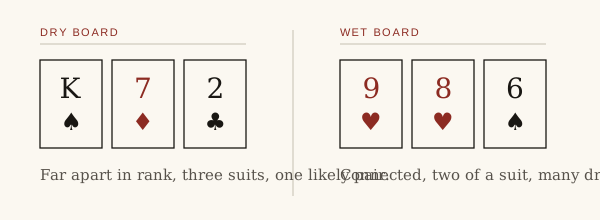
On a dry board, most of the hands the caller kept before the flop have missed completely, and the small number that connected are easy to name. The bet asks the caller to continue with almost nothing, and most of the time there is almost nothing to continue with. On a wet board, the caller holds straight draws, flush draws, pairs of several sizes and combinations that are both a pair and a draw at once. The same bet now asks very little of a range that has a great deal to work with.
A bet on a dry board does not need to be large, because it is not trying to charge a draw or protect against many outs. It is asking a range that mostly missed to fold, and a small bet does that at a lower cost when it fails. A bet on a wet board has a different job: it charges hands that will improve, and it needs to be large enough that continuing with a draw is a genuine expense rather than a formality.
The mistake in the other direction is just as common. Betting large on dry boards risks more to win a pot that was already likely to be conceded, and betting small on wet boards offers a price that makes every draw an easy call. Matching size to texture is the single adjustment that improves the most continuation bets.
Some flops belong to the caller rather than the raiser. Boards made of middling connected cards in the range that callers keep and raisers often discard are the clearest case: the caller's range has hit hard and the raiser's range has not. Checking on those boards is not weakness. It keeps the pot small on a street where the raiser is behind more often than the pre-flop story suggests, and it avoids building a pot that will have to be surrendered on a later street anyway.
The habit worth building is to look at the board and ask which of the two ranges it favours before deciding anything else. If the answer is the raiser, a bet is usually right and the size follows the texture. If the answer is the caller, the cheapest good decision is often to check and see one more card at no cost.