Cash Games

Position is the only edge you are handed for free

Acting last is worth more than any starting hand, because it turns two guesses into one and lets the same cards be played for a wider profit.
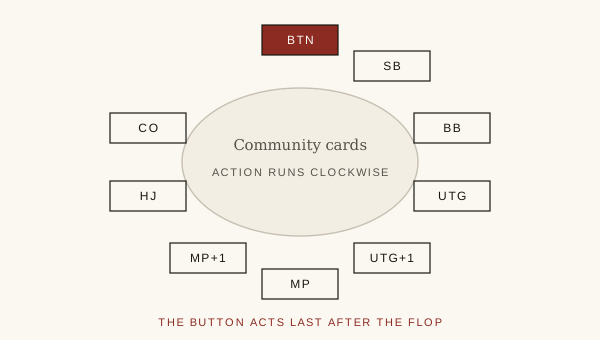
Diagram of seat order at a nine-handed table, showing the button acting last after the flop
Seat order at a nine-handed table: the button acts last on every street after the flop.

Every other advantage in poker has to be earned. Cards are dealt at random, opponents choose their own style, and the size of the pot is the product of decisions nobody controls alone. Position is different. It is assigned by the movement of the dealer button, it rotates on a fixed schedule, and for one hand in every orbit it hands a player the last word on all three streets after the flop. Nothing else at the table is given away so cheaply or wasted so often.

The concrete benefit is informational. A player who acts first has to commit to a bet, a check or a fold without knowing what the other player intends to do. A player who acts last has already watched that decision happen. The same holding, played from the same stack, against the same opponent, is worth measurably more when it is played with that extra piece of information attached to every street.
Read the full story

Also on the front
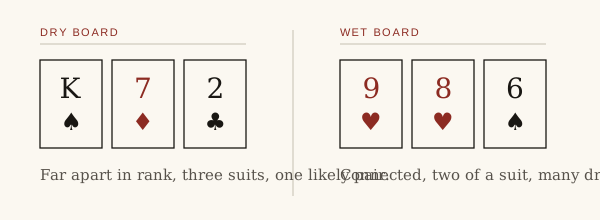
Two board diagrams comparing a dry disconnected flop with a wet coordinated flop
Two flops of the same rank height: the left board connects with almost nothing, the right board connects with a great deal.
Latest briefs
On the sheet
Odds & Maths

The arithmetic under every decision, written out slowly enough to check.

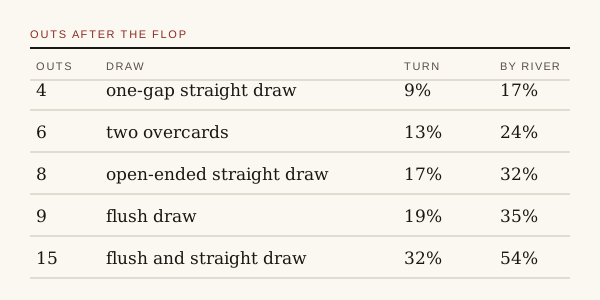
Table plate listing common out counts against the chance of improving on the next card
Outs on the flop, and the price that makes calling break even.

All of Odds & Maths

Tournaments

Rising blinds, shrinking stacks and the places where survival changes the maths.

All of Tournaments

Rules & Formats

How the hand is ranked, how the showdown runs and how the common formats differ.

All of Rules & Formats

From the archive

Discipline is a strategy, not a temperament

The word discipline is usually used at a poker table to describe a personality, as though some players simply have more of it. That is a comfortable way to avoid the real question, which is structural rather than temperamental. A player who sits at a stake where an ordinary losing run is painful will make worse decisions, and no amount of resolve corrects for it.

The same is true of session length. Concentration falls long before it feels as though it has fallen, and the first casualty is the willingness to fold a hand that has become expensive. A stopping point chosen before sitting down is worth more than any intention formed at the table three hours later.

Both are decisions about arrangement rather than character, which is why both can be fixed by anyone. The work is done before the cards are dealt: pick a stake whose swings can be carried without flinching, set a point at which the session ends, and leave the review of individual hands to a moment when nothing is at stake.

More from Bankroll & Discipline