Odds & Maths
Counting outs is easy; counting the ones that actually win is not
The number of cards that improve a hand and the number that win it are rarely the same, and the gap between them is where money leaks.
Poker News Strategy
Cash games, tournaments and the arithmetic behind them
A call is worth making when the chance of winning is greater than the share of the final pot the call has to pay. Everything else is detail.
Most calling decisions reduce to a single comparison. On one side is the price of the call, expressed as the share of the final pot the caller has to put in. On the other is the chance the caller has of holding the winning hand. If the chance is larger than the share, calling is worth it. If it is smaller, folding is.
The pot that matters is the pot after the call, not before it. If the pot holds one hundred and an opponent bets fifty, calling costs fifty into a pot that will then contain two hundred: the hundred that was there, the fifty bet and the fifty called. The price is fifty divided by two hundred, which is one quarter. A call at that price needs to win more than a quarter of the time to be worth making.
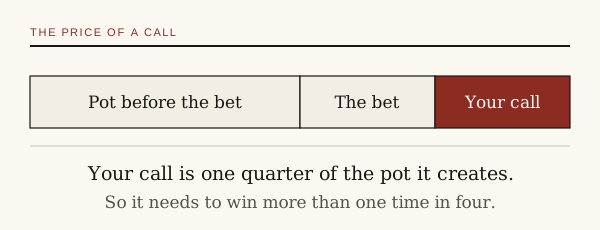
The most common arithmetic error is dividing by the pot before the bet, which produces fifty into one hundred and fifty, or one third, and makes every call look worse than it is. The second most common is forgetting that a call also has to be paid on later streets if the hand continues, which makes some calls look better than they are.
For a drawing hand, the chance of improving can be counted directly. Each card that completes the draw is an out. A flush draw after the flop has nine outs, because thirteen cards of the suit exist and four are already visible. An open-ended straight draw has eight, four at each end. A single-gap straight draw has four. Two overcards to the board have six.
With forty-seven unseen cards after the flop, the chance of hitting on the next card alone is the number of outs divided by forty-seven. A flush draw is therefore a little under one in five to arrive on the turn. Over both the turn and the river together the chance is a little over one in three. A rough guide that is close enough at the table is to multiply outs by four when two cards are still to come and by two when one is, but the multiplication is an approximation and it overstates the larger draws.
Two adjustments matter. The first is that some outs do not win: a card that completes a straight can also complete a better flush for someone else, and a card that pairs a hand can give an opponent trips. Outs that improve the hand without making it the winner should not be counted.
The second is that a drawing hand can win more than the pot currently on the table, because a hand that completes will sometimes be paid on a later street. That prospect can justify a call at a price the immediate comparison rejects, but only when the money is genuinely likely to arrive. Against an opponent who will stop betting the moment the obvious draw completes, it will not, and the simple comparison is the correct one.